
Most homeowners assume raccoons disappear in winter. The trash cans go undisturbed. The backyard stays quiet. Easy conclusion: they must be sleeping somewhere.
That assumption costs Toronto homeowners thousands of dollars every single year.
Because while you think the raccoon outside has gone dormant for the season she’s likely nesting in your attic right now. Staying warm on your insulation. Using your home as her personal den. And quite possibly preparing to give birth there in spring.
At Wildlife Removal Pro, we get more calls about raccoon infestations in winter than any other season. Not summer. Not fall. Winter. And the reason is almost always the same: the homeowner assumed the cold had taken care of the problem for them.
It hasn’t. Let’s talk about why.
Do Raccoons Hibernate?
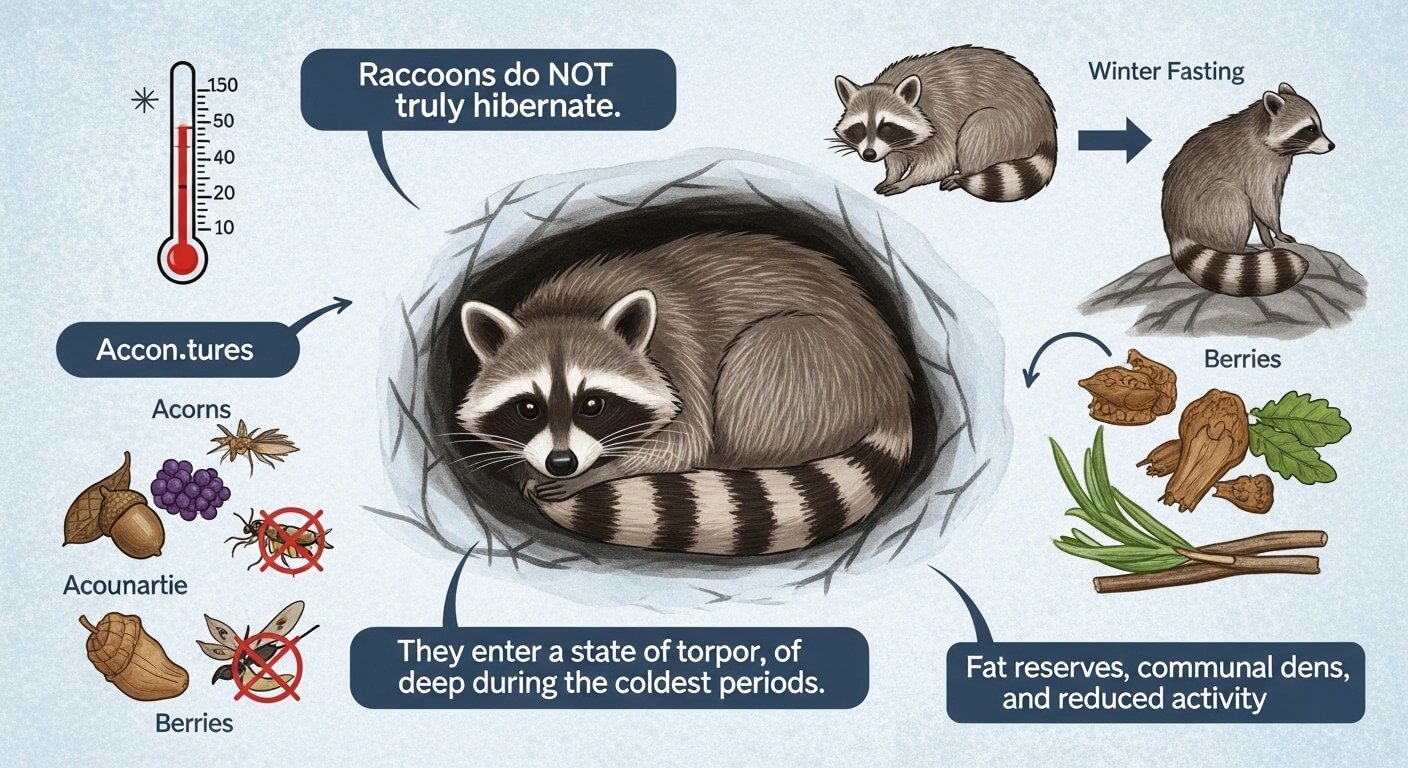
No. Raccoons do not hibernate. They enter a lighter sleep state called torpor and they can wake up and become fully active any time temperatures rise above freezing.
This surprises almost everyone. Raccoons get mentally grouped with bears and groundhogs as “animals that sleep through winter.” But the biology is completely different and the difference matters enormously for your home.
True hibernators groundhogs, certain bat species enter a deep physiological shutdown. Body temperature crashes. Heart rate drops to just a few beats per minute. They cannot be easily roused for weeks at a time.
Raccoons don’t do any of that. A raccoon in torpor still has a near-normal body temperature. She can wake up, fully alert and ready to move, within minutes. Think of true hibernation as a medically induced coma. Torpor is a deep afternoon nap.
That distinction is everything. A hibernating groundhog is genuinely unavailable. A raccoon in torpor is just napping in your attic — and she’ll be up and active the first mild evening this week.
What Is Torpor and How Is It Different from Hibernation?
Torpor is a short-term, reversible metabolic slowdown. The raccoon’s metabolism drops roughly 50%, her heart rate decreases, and stored body fat burns slowly for energy but body temperature stays near normal and she can wake quickly.
Here’s a simple side-by-side comparison:
| Feature | True Hibernation | Raccoon Torpor |
|---|---|---|
| Body Temperature | Drops dramatically | Near normal |
| Heart Rate | Nearly stops | Moderately reduced |
| Metabolism | 95%+ shutdown | ~50% reduction |
| Can Wake Quickly? | No — takes hours or days | Yes — within minutes |
| Duration | Months | Days to a few weeks |
Starting in late summer, raccoons enter what wildlife biologists call a “pre-winter feast” phase. They eat aggressively berries, insects, garbage, whatever they can find building a fat layer that can add 50% or more to their body weight. A healthy adult raccoon heading into a Toronto winter might weigh 20–30 pounds, compared to 12–15 pounds in spring.
That stored body fat isn’t just fuel. Combined with their thick grey coat, which grows considerably denser in autumn, it’s insulation. Raccoons are far better equipped for cold weather than most people realise.
Are Raccoons in Torpor All Winter Long?
Absolutely not. Raccoons rouse regularly throughout winter. Any time temperatures climb above freezing, they wake up, forage for food, and return to their den often your attic.
This is the part that frustrates homeowners most. You go three weeks without a raccoon sighting, feel relieved, assume the problem has resolved itself and then your trash gets completely destroyed on the first mild night in February.
That’s not coincidence. That’s raccoon winter biology working exactly as designed.
In Southern Ontario and the Durham Region, raccoons may sleep for stretches of two to four weeks during the coldest cold snaps. But when a warm front pushes temperatures above 0°C? They’re up. They’re hungry. And they’re heading straight for the most accessible food source they know.
This is something we see consistently at Wildlife Removal Pro, homeowner calls spike dramatically during mid-winter warm spells. Not because new raccoons have suddenly appeared, but because animals already denning inside attics and crawlspaces become active and audible again when the temperature rises.
Never assume a quiet winter means a raccoon-free home. It may simply mean they’re sleeping quietly upstairs.
At What Temperature Do Raccoons Enter Torpor?
Raccoons generally enter torpor when temperatures drop consistently below -9°C (15°F). Above 0°C, expect activity. Between -9°C and 0°C, activity is reduced but entirely possible.
Here’s a practical temperature reference for Ontario homeowners:
- Above 0°C: Full activity possible foraging, travelling, mating behaviour
- -9°C to 0°C: Reduced activity, shorter foraging trips close to the den
- Below -9°C: Most raccoons remain denned; torpor kicks in properly
- Below -23°C sustained: Genuinely dangerous even for healthy raccoons without adequate shelter
The critical word is “consistently.” One cold night won’t push a raccoon into torpor. A week of sustained below -9°C temperatures will. And a single warm evening in the middle of that cold stretch? Enough to bring them out.
When Do Raccoons Come Out at Night in Winter?
In winter, raccoons are most active between dusk and midnight on nights when temperatures are above freezing and wind is calm. Cold, windy nights keep them denned.
This is a noticeable shift from their summer behaviour. In warmer months, raccoons are active from dusk to dawn fairly reliably. In winter, they compress that window — shorter foraging trips, staying closer to the den site, returning before the coldest pre-dawn hours.
Three factors consistently trigger a winter outing in the Greater Toronto Area:
1- Temperature above freezing. Around 2–4°C seems to be the reliable activity threshold based on wildlife removal calls across Toronto, Mississauga, and the Durham Region.
2- Accessible food. Raccoons have exceptional olfactory senses. A garbage bin put out the night before a mild spell is practically an engraved invitation. In urban Toronto neighbourhoods, reliable food sources are never far.
3- Mating drive. February and March mark the start of raccoon breeding season across Ontario. Male raccoons dramatically increase their ranging behaviour during this period travelling much farther than usual in search of females. This is why late-winter raccoon sightings spike even in cold years.
One pattern worth noting: raccoons are less active during and immediately after heavy snowfall. Snow muffles scent trails and makes foraging harder. But the evening after a snowfall, when temperatures creep up? Expect activity.
Where Do Raccoons Live During Winter?
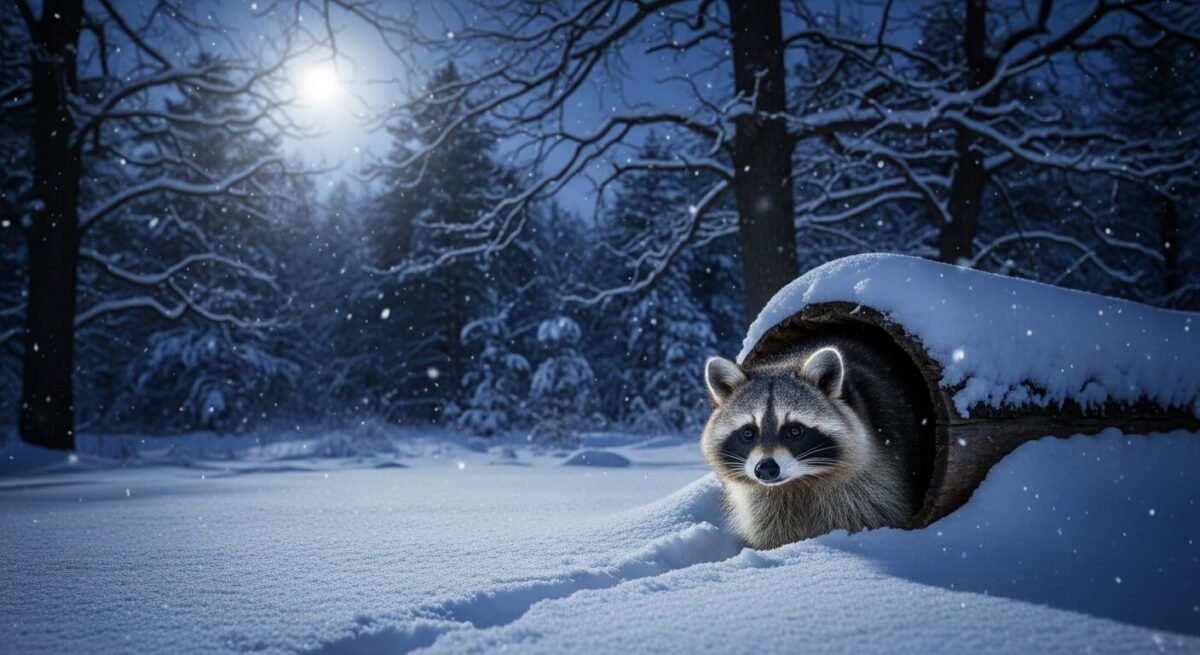
Raccoons seek warm, enclosed den sites for winter tree hollows and rock crevices in natural areas, but increasingly attics, chimneys, and crawlspaces in Toronto’s suburban and urban neighbourhoods.
In undeveloped areas, raccoons use tree hollows, rock crevices, and abandoned burrows they rarely dig their own. A deep, well-insulated tree hollow is ideal natural den habitat.
But here’s the reality in Toronto and the surrounding municipalities: mature hollow trees are rare. The urban and suburban landscape has eliminated most of the natural den architecture raccoons evolved to use. Your attic isn’t an attractive nuisance. For a raccoon navigating the GTA, it’s genuinely the best option available.
Attics offer everything a raccoon needs for winter survival:
- Warmth typically 10–15°C warmer than outside due to heat rising from the home
- Insulation material to compress and nest in
- Darkness and isolation from predators
- Proximity to food sources in surrounding neighbourhoods
Beyond attics, Wildlife Removal Pro regularly finds raccoons denning in:
- Chimneys uncapped masonry chimneys mimic hollow trees almost perfectly. Female raccoons actively prefer chimneys for raising young due to the vertical shaft, which provides security from ground predators.
- Crawlspaces especially under older Toronto homes with unsealed or deteriorating skirting
- Garages and sheds gaps along rooflines or damaged soffits are common, easy entry points
- Under porches and decks more common as a spring denning site, but used in winter when other options are limited
One fact that changes everything: a raccoon that finds a good winter den site returns to it year after year. She brings her offspring, who learn den site selection from her. A single unaddressed entry point in your soffit can mean 10 to 15 raccoons using your home over a few seasons.
What Do Raccoons Eat in Winter?
Raccoons are opportunistic omnivores and in winter, suburban food sources consistently outcompete natural ones. Your garbage, bird feeders, compost bin, and outdoor pet food are their primary winter targets.
Natural winter food sources include frozen or fermented fruit remaining on trees and shrubs, dormant insects and larvae under bark, small mammals, fish from partially frozen waterways, and cached nuts and seeds. In a rural environment, this diet sustains them.
In urban Toronto? They barely need any of it.
Here’s what actually draws raccoons to your property in winter:
- Unsecured garbage bins are the single biggest attractant. Raccoons learn collection schedules in neighbourhoods within weeks — they know when your bin goes out.
- Bird feeders loaded with sunflower seeds or mixed seed are an easy, calorie-dense meal requiring minimal energy to access.
- Outdoor pet food left out after dark is essentially an open invitation. Even in cold weather, it will be found.
- Compost bins without raccoon-proof lids are accessed regularly. Even “green” kitchen scraps in winter are nutritionally valuable to a food-motivated raccoon.
One finding from wildlife research that surprised me: urban raccoons in cities like Toronto have measurably higher body weights in winter than raccoons in rural areas of the same latitude. Human food waste is that nutritionally dense compared to natural winter forage.
Do Raccoons Freeze to Death?
Healthy adult raccoons rarely freeze to death. Their thick fur insulation, torpor capability, and stored body fat make them surprisingly cold-hardy. Young raccoons, injured animals, and those in poor body condition are the genuinely at-risk group.
A healthy adult raccoon with a good den site and adequate fat reserves can survive sustained temperatures well below -20°C. Their dense winter coat provides excellent insulation, trapping body heat effectively. During torpor, reduced metabolic demands mean fat stores stretch considerably further.
The situations where cold becomes genuinely dangerous:
Young raccoons born late in the season kits born in late summer may not have had adequate time to build fat stores or develop full winter coats before cold arrives. Early November cold snaps are genuine mortality events for young-of-year raccoons in Ontario.
Raccoons displaced from den sites an animal caught out in the open during a sudden cold snap, unable to reach shelter, faces real risk. This is one reason raccoon exclusion work done improperly in winter — by inexperienced operators or as a DIY project — can create serious animal welfare problems and legal liability under Ontario’s Fish and Wildlife Conservation Act.
Raccoons with mange or injuries — mange strips fur insulation. Injuries limit foraging ability and fat building. These animals are genuinely vulnerable and should be reported to a licensed wildlife rehabilitator.
A healthy raccoon you encounter in your neighbourhood in January is not suffering from the cold. She’s warm, she’s well-fed, and she’s likely sleeping in someone’s attic.
Raccoon Diseases: What Most Wildlife Articles Don't Tell You
This is the section missing from most competitor content and it’s arguably the most important health information for any homeowner dealing with a raccoon infestation in Ontario.
Raccoons carry four diseases that present genuine human health risks:
Rabies — Raccoons are one of the most common rabies vector species in Ontario. A raccoon that is active during daylight hours, moving erratically, or appearing disoriented should be treated as potentially rabid. Never handle a raccoon with bare hands under any circumstances.
Raccoon Roundworm (Baylisascaris procyonis) — This is the one most Ontario homeowners have never heard of, and it’s arguably the most dangerous, particularly for children.
Raccoon faeces contain roundworm eggs that can survive in soil for years. Accidental ingestion through contaminated soil on hands, a particular risk for young children playing near latrine sites can cause severe neurological damage. Any attic remediation involving raccoon faeces requires N95 respiratory protection and disposable protective clothing at minimum. This is not a DIY situation.
Leptospirosis — A bacterial infection spread through raccoon urine, capable of causing kidney and liver failure in humans. Raccoon urine contamination in an attic or crawlspace is a serious concern, especially if there are any areas where moisture could carry contaminated material toward living spaces.
Tularemia — Less commonly associated with raccoons but a genuine risk when handling dead animals without proper protection.
The practical conclusion: attic remediation after raccoon occupation is not a DIY project. Professional decontamination, insulation removal and replacement, and full sanitisation in the Greater Toronto Area typically runs $1,500–$4,000 depending on the extent and duration of the infestation. That cost is entirely avoidable with early prevention.
Signs of a Winter Raccoon Infestation in Your Home
Most Toronto homeowners hear raccoons long before they find visual evidence. Heavy, deliberate footsteps in the ceiling not scurrying, but actual walking are the most reliable early warning sign.
Here’s what to listen and look for:
Sounds from above:
- Heavy, deliberate footsteps in the ceiling or walls — raccoons weigh 5–14 kg. It sounds like a person walking, not a mouse or squirrel.
- Rolling or thumping sounds, especially if young kits are present
- Vocalisation — chattering, chirping, or a distinctive churring sound at dusk
Exterior evidence during a daylight inspection:
- Torn, bent, or displaced vent covers along the roofline or soffits
- Dark, greasy staining around potential entry points — this comes from their fur
- Claw marks on wood, siding, or painted surfaces near the roofline
- Compressed or matted insulation visible through soffit gaps
Ground-level evidence:
- Communal latrine sites — raccoons defecate in the same spots repeatedly. Look for concentrated waste on flat roof sections, around tree bases, on deck railings, or on top of woodpiles.
- Garbage bins with lids forced off rather than simply tipped
- Bird feeders with bent or broken mounting hardware, or completely emptied overnight
If you notice any combination of these signs, contact a licensed wildlife removal company for an inspection before the problem escalates. At Wildlife Removal Pro, we conduct full property assessments and can identify entry points you may not have noticed.
Don’t let Wildlife cause more damage to your assets.
Act Now and Book an Immediate Animal Inspection!
Call Now!
How to Prevent Raccoons from Invading Your Home This Winter
Effective raccoon prevention combines structural exclusion, attractant elimination, and correct timing. Any one of these alone produces temporary results at best.
Here’s an honest breakdown of your options, in order of effectiveness:
Structural Exclusion — Most Effective
The most reliable long-term solution is working with a licensed Ontario wildlife control operator to seal all potential entry points using raccoon-grade materials heavy gauge galvanised wire mesh, metal flashing, and concrete or caulking where appropriate.
At Wildlife Removal Pro, every exclusion job begins with a full perimeter inspection not just the obvious entry point. Raccoons are intelligent animals that will find secondary entry points within weeks if the initial closure isn’t part of a comprehensive seal.
Typical exclusion costs in the GTA: $350–$900 for an average residential property. Compare that to $1,500–$4,000 for full attic remediation after a family has denned and given birth. The maths is straightforward.
What to require from any wildlife contractor in Ontario:
- Full perimeter inspection documented with photos
- Metal closures — never plastic, which raccoons destroy within hours
- Minimum one-year warranty on all exclusion work
- Valid Ontario Ministry of Natural Resources and Forestry (MNRF) wildlife control licence
Attractant Elimination — Essential, DIY
Structural exclusion is significantly less effective if your property remains a reliable food source. Address the attractants:
- Raccoon-resistant garbage bins with locking lids or bungee closures. Quality locking bins like the Toter series ($75–$140 CAD) hold up well against determined raccoons.
- Bring bird feeders in each evening from November through March. No exceptions if you’ve had raccoon activity.
- Sealed compost bins with raccoon-proof bases. Open pile composting in Toronto’s urban environment is a significant raccoon attractant.
- No outdoor pet food after dusk. Ever. Even in cold weather, leftover food will be found.
- Motion-activated lighting near entry points adds friction without being a standalone solution.
Chimney Caps — Critical and Often Overlooked
An uncapped masonry chimney is one of the most reliable raccoon attractants in older Toronto homes. Female raccoons actively seek them as maternity dens because the vertical shaft mimics a hollow tree almost perfectly.
A professional-grade stainless steel chimney cap costs $175–$350 installed. Chimney remediation and sanitisation after raccoons have denned and given birth costs $2,000–$4,500. This is one of the highest return-on-investment preventative measures available to Toronto homeowners.
Trapping and Relocation — Least Effective as a Standalone
Here’s the honest industry truth that many pest control companies won’t lead with: trapping and relocating raccoons without concurrent exclusion has a very high recurrence rate. New raccoons move into vacated territories within weeks to months. The food source and den site that attracted the original animal are still there they’ll attract another.
Trapping makes sense as part of an integrated approach: remove animals currently inside, then immediately seal all entry points before new animals can investigate. As a standalone service, it solves the symptom without addressing the cause.
It’s also worth noting that under Ontario’s Fish and Wildlife Conservation Act, raccoons can only be legally trapped and relocated within one kilometre of the capture site. Licensed wildlife removal operators in Ontario must comply with this regulation and any company offering to relocate raccoons “far away” should raise a red flag.
Bottom Line
Raccoons don’t hibernate. They nap and they wake up the first mild evening to forage your neighbourhood, raid your garbage, and remind you they’ve been living in your attic all along.
The Toronto homeowners who handle this well do three things: they seal entry points before breeding season, they eliminate attractants consistently, and they work with licensed wildlife professionals who understand raccoon biology not just trapping.
The homeowners who struggle do one thing: they assume winter means raccoons are someone else’s problem until spring. By then, they’re sharing their attic with a mother and four kits, facing a $3,000 remediation bill that a $500 exclusion job in October would have entirely prevented.
Winter is not raccoon off-season. In the GTA, it’s their home-invasion season.
If you’ve noticed any signs of raccoon activity in or around your home this winter, don’t wait until spring. Contact Wildlife Removal Pro for a full property inspection the earlier we address it, the simpler and less costly the solution.
Have questions about raccoon behaviour or prevention? Drop them in the comments below we read and respond to every one.
