
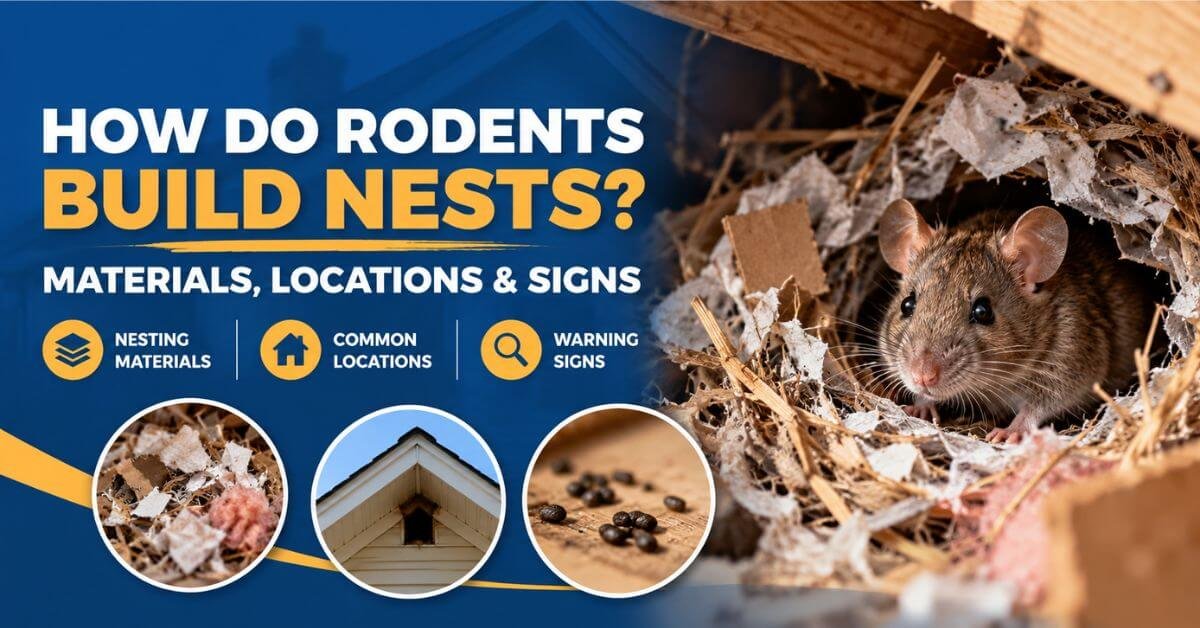
Rodents build nests by collecting, shredding, and arranging soft materials such as paper, cardboard, fabric, insulation, grass, and leaves. They usually make nests in quiet, protected areas like attics, wall cavities, garages, crawl spaces, and storage spaces. Rodents build these nests for shelter, resting, temperature regulation, and raising their young. Finding a nest can indicate rodent activity, but the nest alone does not confirm that rodents are still present.
How Do Rodents Build a Nest? Step by Step
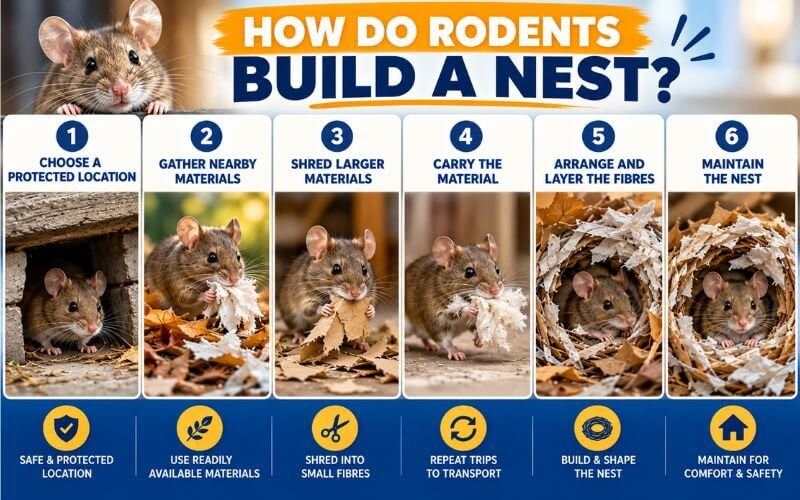
Rodent nest construction is a simple but adaptable process. The exact structure varies with the species, location, available materials, and surrounding conditions.
- Choose a protected location: Rodents look for areas with limited disturbance and shelter from environmental conditions.
- Gather nearby materials: They often select materials close to the nesting site because shorter trips reduce travel and make construction easier.
- Shred larger materials: Paper, cardboard, fabric, insulation, and other materials can be torn into smaller fibres that are easier to move and arrange.
- Carry the material: A rodent may make repeated trips between the material source and the nesting location.
- Arrange and layer the fibres: Materials may be pulled, pushed, layered, and compacted to create a loose or more enclosed nest.
- Maintain the nest: A suitable site may continue to be used when shelter, food access, and other conditions remain favourable.
What Materials Do Rodents Use to Build Nests?
Rodents are adaptable and generally use materials readily available near the nesting area. Common examples include:
- Paper and Cardboard
- Fabric and Clothing
- Insulation
- Grass, Leaves, and Plant Fibres
- Other Available Materials
Why Do Rodents Build Nests?
A rodent nest provides a protected place for resting and raising young. Nesting materials can also help create a more stable environment around the resting area.
- Protection and shelter: A concealed nest can reduce exposure to disturbance and environmental conditions.
- Temperature regulation: Soft nesting materials can provide insulation around the resting area.
- Resting: Rodents may use nests as sheltered resting spaces between periods of activity.
- Raising young: During reproduction, a sheltered nest can provide young rodents with a warmer and more protected environment.
Where Do Rodents Usually Build Nests?
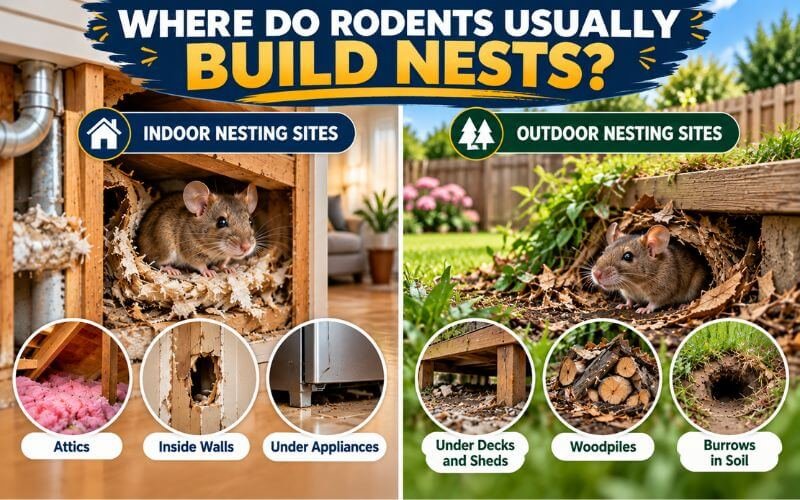
Nesting locations depend on species, building design, surrounding conditions, and available shelter.
Indoor Nesting Sites
- Wall cavities: Narrow spaces with limited disturbance.
- Attics: Sheltered areas that may contain insulation and nesting material.
- Garages: Spaces that provide shelter and accessible storage for materials.
- Crawl spaces: Concealed areas with limited regular activity.
- Storage areas: Boxes, fabrics, and household materials can create nesting opportunities.
Outdoor Nesting Sites
- Elevated areas: Roof rats may use higher, protected locations when access is available.
- Under structures: Spaces beneath decks, sheds, and similar structures can provide shelter.
- Burrows: Some rat species may create or use burrows near suitable structures.
- Sheltered ground areas: Protected spaces close to buildings can provide cover.
- Protected vegetation: Dense plants can offer shelter and concealment.
How Do Mice Build Their Nests?
Mice collect soft, accessible materials such as paper, fabric, insulation, grass, and other fibres. They often shred these materials before arranging them in protected spaces. In Toronto homes, wall cavities, attics, and other enclosed areas can provide suitable nesting locations. A finished mouse nest may look loose, compact, or irregular, and appearance alone may not identify the species.
How Do Rats Build Their Nests?
Rats also gather and arrange available materials, but their nesting behaviour varies by species and environment. Norway rats are commonly associated with lower areas, ground-level shelter, and burrows, while roof rats are more associated with elevated locations such as attics and higher parts of buildings. These are general tendencies, not fixed rules; once rats enter a building, they may use any sheltered area that meets their needs.
What Does a Rodent Nest Look Like?
There is no single appearance for a rodent nest. Materials, location, species, and nest age can all affect its structure. Indoor nests may contain shredded paper, cardboard, fabric, or insulation, while outdoor nests may contain grass, leaves, bark, and other natural fibres.
Useful clues include:
- Shredded paper, cardboard, fabric, or insulation
- A loose or compact pile of fibres
- A concealed location with limited disturbance
- Disturbed material around the suspected nesting area
- Other evidence such as droppings, gnawing, food disturbance, or repeated sounds
Rodent Nest vs. Bird or Squirrel Nest
| Animal | Common Materials | Typical Clues |
|---|---|---|
|
Rodents |
Shredded paper, fabric, insulation, fibres |
Often concealed in walls, attics, or other sheltered spaces |
|
Birds |
Twigs, grass, plant material |
Often arranged as a visible structure in elevated locations |
|
Squirrels |
Leaves, branches, natural material |
Often larger and more exposed, depending on location |
If a nest looks larger, more exposed, or is mainly built from leaves and branches, it may belong to a squirrel rather than a rodent. Nest appearance and location can provide clues, but visual identification is not always conclusive.
How Can You Tell If a Rodent Nest Is Active?
Finding a nest does not prove that rodents are still using it. Old nests can remain after an animal leaves, so current activity should be assessed using several signs together.
| Sign | What it may indicate |
|---|---|
|
Fresh or recently disturbed droppings |
Possible recent rodent activity |
|
New gnawing or damage |
Recent movement or feeding activity |
|
Recently disturbed nesting material |
Possible current use of the area |
|
Repeated sounds from walls or ceilings |
Possible movement in a concealed space |
|
Food disturbance |
Possible recent access or activity |
Where Do Rodents Build Nests in Toronto Homes?
Toronto homes can contain many sheltered spaces that rodents may use for nesting, including attics, wall cavities, garages, crawl spaces, and insulated areas. Older homes can contain concealed gaps around building components, while renovations may leave openings around pipes, vents, utility lines, and other penetrations.
During an inspection, the visible nest is only one part of the investigation. The access route can be just as important because it explains how the animal reached the nesting area.
Why Can Toronto Homes Provide Suitable Nesting Spaces?
- Attics can combine insulation with limited human activity.
- Garages and storage areas may provide both shelter and accessible materials.
- Wall cavities can offer concealed routes and protected nesting locations.
- Building openings around vents, pipes, utility lines, roof components, or other penetrations can provide access.
- Property design, landscaping, maintenance, and available shelter can influence where rodents establish nests across the Greater Toronto Area.
How Rodent Nests Can Help Reveal an Entry Point
The nesting location is not always the entry point. Rodents may travel through concealed spaces after entering through a different part of the building. For that reason, finding the nest should be followed by an assessment of possible routes between the nesting area and exterior openings.
- Inspect roofline and soffit areas for gaps or damaged sections.
- Check vents and openings where screens may be damaged.
- Look around utility lines, pipes, and other wall penetrations.
- Check garage openings and damaged door seals.
- Inspect foundation-level gaps and other accessible exterior openings.
- Look for gnawing, rub marks, droppings, or disturbed material near possible routes.
Do not open concealed walls or disturb insulation simply to search for a nest. Hidden nesting areas may require a professional inspection, especially when the location or activity is unclear.
What Can a Rodent Nest Mean for Your Home?
A rodent nest confirms that an animal has used the area for shelter, but it does not automatically prove that the animal is still present.
- Rodent activity may disturb insulation and other building materials.
- Movement through concealed spaces can leave damage that is difficult to see from living areas.
- A nest can indicate that a rodent found a suitable shelter location inside or near the property.
- The most useful question is often not only where the nest is, but how the animal gained access.
What Should You Do If You Find a Rodent Nest?
- Avoid disturbing the nest unnecessarily.
- Keep children and pets away from the area until you understand what you have found.
- Do not handle unknown nesting material with bare hands.
- Look for other signs of recent activity and accessible entry points.
- Do not rely on the visible nest alone when deciding whether rodents are still present.
Removing the visible nest without addressing the access route may not solve the underlying problem. If rodents can enter the property again, another nesting site may develop.
Should You Remove a Rodent Nest Yourself?
Removing visible nesting material does not address how the animal entered the property. The nest may also be inside a wall, ceiling, or insulation, where unnecessary disturbance can create additional problems. If the nesting area is concealed or there are multiple signs of activity, a professional assessment can help determine the appropriate next step.
Can Rodent Nests Damage a Home?
A rodent nest can affect insulation and other materials, especially when nesting occurs in concealed building spaces. Rodents moving around the property may also leave gnawing damage or other signs of activity. The level of damage depends on the location, duration of activity, and building materials involved. Early investigation can help identify access points before the problem becomes more extensive.
Need Help Identifying or Removing a Rodent Nest?
A professional rodent control Toronto inspection can identify the nesting area, assess evidence of current activity, and locate potential access points before a full removal. This approach focuses on understanding both the visible nest and the route the animal used to reach it.
Frequently Asked Questions
There is no fixed time frame for every species. Construction depends on the rodent, nest size, material availability, location, and surrounding conditions. Nesting can begin quickly when suitable materials and shelter are readily available.
Yes. Rodent nests can provide protection for young animals and can create a warmer, more stable environment during early development.
Nest use varies by species and situation. A suitable location may continue to be used when shelter, food access, and other conditions remain favourable.
Yes. Some rodents can establish nests inside wall cavities because these spaces provide shelter and limited human disturbance.
Yes. Attic insulation can provide both nesting material and shelter. However, disturbed insulation alone should not be treated as proof of active rodent activity.
