
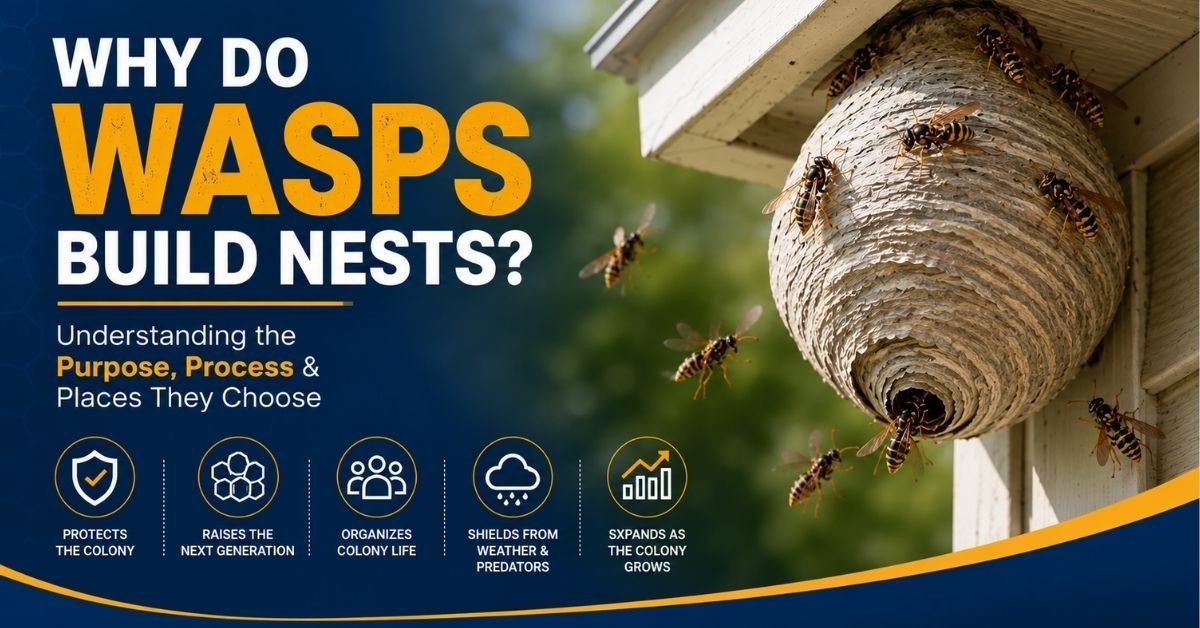
Wasps build nests primarily to provide a protected place to reproduce, raise their young, and support the needs of a colony. For social wasps, the nest becomes the centre of colony life, containing the developing brood and expanding as more workers are produced. The exact structure and location depend on the species, but wasps generally select sites that offer suitable protection, support, and environmental conditions.
That raises a more useful question for homeowners: why would a wasp choose your house, roof, soffit, attic, wall, deck, or shed as a nesting site? Understanding how wasps select and construct nests can help explain why activity appears in one particular area and why a seemingly small nest can become much more noticeable as the season progresses.
What Is the Purpose of a Wasp Nest?
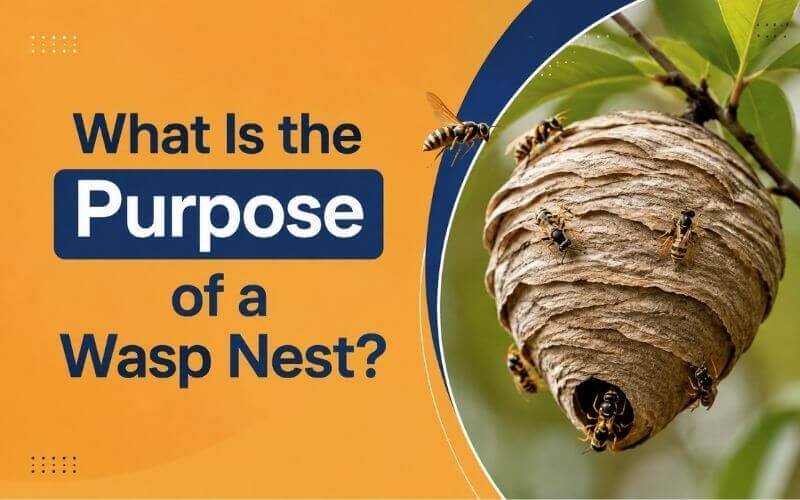
The purpose of a wasp nest goes far beyond giving adult wasps somewhere to live. For social species, the nest provides the structure needed for reproduction, brood development, food delivery, protection, and colony growth.
To Protect Eggs and Larvae
A nest provides protected spaces where eggs can develop, and larvae can be raised.
In social wasps, the female reproductive individual lays eggs into individual cells within the nest. Workers then care for the developing young by bringing food and maintaining the colony. The nest therefore functions as a nursery as well as a living structure.
The exact arrangement varies between species, but the basic biological purpose remains the same: the developing offspring need a protected place where the colony can care for them.
To Raise the Next Generation
A successful social wasp colony depends on producing new workers and, later in the season, reproductive individuals.
Early in the colony cycle, the founding queen may perform much of the nest construction and food collection herself. Once the first workers mature, they can take over jobs such as foraging, nest construction, brood care, and colony defence while the queen concentrates primarily on laying eggs.
This division of labour is one reason a nest can change dramatically over the course of a season.
To Shelter and Organize the Colony
A mature social wasp nest is effectively the colony’s central infrastructure.
It provides places for developing young, surfaces for expansion, and protected areas where workers and reproductive individuals can remain when they are not foraging. Different species have evolved different nest architectures because their colonies have different requirements. That is why a small open paper-wasp nest can look completely different from an enclosed yellowjacket or hornet nest.
To Protect Developing Wasps From Weather and Predators
Nest construction also creates a physical barrier between developing insects and the outside environment.
A suitable nesting site may protect from rain, wind, excessive exposure, predators, and physical disturbance. The Natural History Museum describes suitable sites for social wasps in terms of being dry, safe, and structurally sound enough to support the nest. The nest itself can add another layer of protection, depending on the species and its architecture.
The Nest Expands Because the Colony Expands
A wasp nest is not necessarily built to its final size from the beginning.
A newly established social colony may start with a relatively small structure. As workers emerge and the number of developing larvae increases, additional cells and structural material can be added:
new colony → more brood → more workers → more construction → larger nest
This relationship between colony growth and nest expansion is one of the most important reasons a nest that initially appears insignificant can become much more noticeable later in the season.
How Do Wasps Build Their Nests?
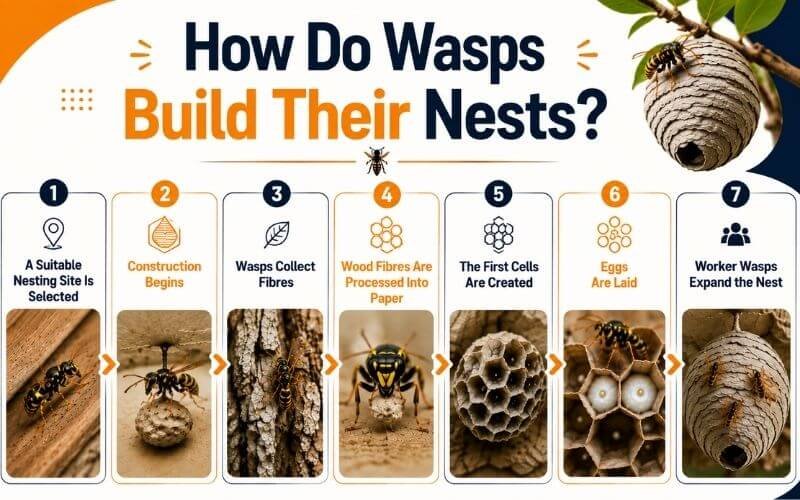
The construction process depends on the species, but many familiar social wasps, including paper wasps, yellowjackets, and hornets, use plant or wood fibres to create paper-like nest material. Other wasps use mud, soil, grass, pre-existing cavities, or other materials.
Step 1: A Suitable Nesting Site Is Selected
For social wasps that establish new colonies, the first stage is finding a location that can support the nest.
The site needs to meet the colony’s basic requirements. Depending on the species, useful characteristics can include shelter, structural support, protection from weather, suitable temperature conditions, and access to nearby resources. This is why protected parts of buildings can sometimes become attractive nesting locations.
Step 2: Construction Begins
The founding female begins creating the initial structure.
In paper-nest-building species, this may involve creating a small attachment point or stalk, known as a petiole, from which the first cells are supported.
Step 3: Wasps Collect Fibres
Paper-nest-building wasps collect weathered wood and other suitable plant-based fibres from their surroundings.
They may obtain material from naturally weathered wood, branches, fences, or other exposed cellulose sources. Around buildings, suitable material can sometimes be available close to the nesting site.
Step 4: Wood Fibres Are Processed Into Paper
The collected fibres are chewed and mixed with saliva and moisture to create a workable pulp. Once deposited and allowed to dry, the material forms the characteristic layered, paper-like structure associated with many social wasp nests, which is why wasps are often described as natural paper-makers. This is not manufactured paper as you’d find in a notebook; it’s a natural composite the wasps build themselves, layer by layer.
Step 5: The First Cells Are Created
The processed material is shaped into cells that provide individual spaces for developing offspring.
In many social wasps, the cells have a hexagonal arrangement, allowing many compartments to be organized within a relatively compact structure.
Step 6: Eggs Are Laid
The founding female lays eggs into the cells as the nest develops.
The eggs hatch into larvae, which remain within the nest while they develop. The adults provide the care and food required by the developing brood.
Step 7: Worker Wasps Expand the Nest
Once the first generation of workers matures, the colony’s workload changes. Workers increasingly handle:
- Collecting food
- Caring for larvae
- Gathering building material
- Expanding the nest
- Defending the colony
The queen can then devote much more of her time to reproduction. This queen-to-worker transition is a major turning point in the development of a social wasp colony.
What Are Wasp Nests Made Of?
There is no single material used by every wasp species. Nest construction varies widely across the wasp family.
Wood Fibres and Plant Material
Paper wasps, yellowjackets and several hornet species construct nests from chewed wood or other plant fibres mixed with saliva.
The resulting material dries into a lightweight but surprisingly durable paper-like structure.
Mud, Soil and Other Materials
Some solitary wasps use mud or soil to construct individual brood chambers. Others excavate tunnels or use existing cavities rather than building a large communal paper nest.
This is why the phrase “wasp nest” does not always mean a large grey paper ball hanging from a tree. Canada’s species information notes that vespid wasps may construct nests from mud or chewed plant material, or create tunnels in wood or soil.
How Do Wasps Choose Where to Build Their Nests?
This is one of the most important questions when a nest appears around a home. Wasps do not necessarily choose a location because they “like houses.” A building can simply provide several of the physical conditions that make a site suitable for nesting.
Protection From Rain and Wind
Sheltered areas can reduce direct exposure to weather. Overhangs, soffits, eaves, and enclosed cavities can protect a nest from heavy rain and strong winds.
Temperature and Local Microclimate
Temperature affects insect activity and development. A protected cavity or sheltered part of a building can create a different microenvironment from a fully exposed location, and suitability can vary by species and season.
Structural Support
A nest needs something stable to attach to or occupy. Branches, building components, cavities, roof structures, wall spaces, and other protected surfaces can provide suitable support depending on the species.
Access to Food and Water
The nesting site does not necessarily need to contain the colony’s food supply. Adult wasps can forage away from the nest, so a location can be useful simply because it provides secure shelter while food and water are available nearby.
Around residential properties, gardens, flowering plants, outdoor food, garbage, fallen fruit, and other resources can influence where wasps are observed. Canadian government guidance notes that social wasps are common in urban and rural environments and that some species scavenge around garbage.
Protection From Predators and Disturbance
A concealed cavity can offer protection that an exposed location does not.
However, “protected” does not mean “safe for people.” A nest hidden inside a wall or roof can be more difficult to identify and may bring wasp activity into areas where people live.
Enough Space for Colony Expansion
For social species, the nesting location must accommodate a growing colony, which makes the size and structure of the available space relevant, particularly for species that construct larger enclosed nests.
Why Do Wasps Build Nests on Houses?
Homes can unintentionally offer many of the characteristics some wasps seek in a nesting location.
Roof Eaves and Overhangs
The underside of eaves and overhangs can provide shelter from direct rain and sunlight while offering a stable surface for certain paper wasps.
Attics and Wall Voids
Enclosed structural spaces can provide protected nesting environments for some species.
A homeowner may notice wasps entering and leaving a small opening without ever seeing the nest itself.
Garages, Sheds and Outbuildings
Detached structures can contain sheltered corners, roof spaces, wall cavities and other protected areas that may be suitable for nesting.
Decks and Porches
The underside of decks, porch structures and other horizontal surfaces can provide sheltered areas.
Trees, Shrubs and Natural Structures
Not every nest around a property is associated with the building itself.
Wasps may also use trees, branches, vegetation, soil, cavities and other natural structures. The preferred site depends heavily on the species and its nesting strategy.
Why Toronto Homes Can Provide Suitable Nesting Conditions
Toronto’s mix of detached and semi-detached homes, townhouses, garages, sheds, mature trees, gardens and older structures creates many potential shelter points. Across Toronto and the GTA, wasp activity may appear around rooflines, soffits, decks, garages, gardens and structural cavities. The key point is that homes can provide suitable nesting conditions; they do not inherently “attract” every wasp species.
What Attracts Wasps to a Property?
A property can support wasp activity because it offers both nesting opportunities and nearby food or water. Common factors include:
- Flowering plants and vegetation
- Ripe or fallen fruit
- Outdoor food and sugary drinks
- Garbage and recycling
- Accessible water
- Sheltered eaves, sheds, garages and cavities
Food or water nearby does not necessarily mean the nest is on the property. Wasps may forage away from the colony.
How Nest Appearance Varies by Species
Nest appearance varies by species. Paper wasps typically create open combs, while many yellowjackets and some hornets construct enclosed paper nests. Solitary wasps may use mud, soil, plant stems, wood cavities or existing holes.
The nest’s appearance and location can provide useful clues, but they are not always enough for reliable species identification.
Do All Wasps Build the Same Type of Nest?
No. This is an important distinction because “wasps” represent a large and diverse group of insects. Some are social and build communal nests, while many others are solitary and construct individual brood chambers or use existing spaces.
Paper Wasp Nests
Paper wasps typically build open, umbrella-like nests with exposed cells, commonly attached beneath protected surfaces such as eaves, overhangs, branches, and other structures.
Yellowjacket Nests
Many yellowjackets construct enclosed paper nests underground, although some species can establish nests in structural cavities or other protected locations. The entrance may be the only obvious external sign of an underground colony.
Hornet Nests
Some wasps commonly called hornets, such as bald-faced hornets, build larger enclosed paper nests, often in trees or protected structural spaces, depending on the species. “Hornet” is also a common-name category that can create confusion, because not every insect called a hornet belongs to the true hornet genus.
Not sure which species you’re dealing with? Body shape, colour and behaviour are covered in detail in our wasp identification guide.
Solitary Wasp Nests
Solitary wasps generally do not create large colonies like social yellowjackets, paper wasps and hornets.
An individual female may construct or occupy a small nesting space for her offspring. Depending on the species, that may involve soil, mud, plant stems, wood cavities, pre-existing holes, or other protected spaces.
Wasp Nest Comparison
| Wasp group | Typical nest structure | Common locations | Social or solitary |
|---|---|---|---|
|
Paper wasps |
Open, umbrella-shaped paper comb, exposed cells |
Eaves, overhangs, branches, sheltered structures |
Social |
|
Yellowjackets |
Enclosed paper nest |
Often ground, wall voids, or cavities |
Social |
|
Bald-faced hornets / some hornets |
Enclosed paper nest |
Trees, roof overhangs, protected structures |
Social |
|
Solitary wasps |
Individual chambers or cavities |
Soil, mud structures, cavities and other protected spaces |
Solitary |
This table is a general guide rather than a species-identification tool. Nest architecture and colouring can vary within these groups, and a suspected active nest should still be assessed by a professional before removal is attempted.
Why Are Wasp Nests Hexagonal?
The familiar six-sided cells are a feature of many social wasp nests, particularly paper-nest-building species.
Why Wasps Use Hexagonal Cells
Hexagonal cells allow many compartments to fit closely together while sharing boundaries, making efficient use of nest material and available space. Individual cells provide protected compartments for eggs and developing larvae, forming part of the nest’s overall brood-rearing structure rather than functioning simply as decorative shapes.
How Nest Structure Changes as the Colony Grows
The nest can be expanded as the colony’s requirements increase. Workers add new construction and maintain existing parts of the nest, allowing the structure to accommodate additional brood and colony members.
When Do Wasps Build Nests?
For many temperate social wasps, nest establishment begins in spring as overwintered queens become active. Timing varies with species and weather.
Wasp Nest Building in Spring
A surviving queen searches for a suitable nesting site and begins to establish the new colony. In many annual-colony species, the previous year’s workers do not survive the winter, so the new colony starts again rather than simply moving back into the old nest.
What the Queen Does Before Workers Emerge
During the early stage, the founding queen may be responsible for nest construction, gathering food, laying eggs, and feeding developing larvae, which makes the early nest-building phase relatively dependent on a single reproductive female.
Toronto Wasp Nest Season, Month by Month
Timing varies with species and weather, but Toronto and GTA activity generally follows this pattern:
- Spring (April–May): Queens emerge from overwintering and start new colonies; the best window for a preventive inspection.
- June–July: Worker wasps hatch and the colony expands quickly; nests become more visible and traffic around entry points increases.
- August–September: Colonies hit peak population and can house hundreds to over a thousand wasps. Food becomes scarcer, wasps grow more aggressive, and most sting incidents occur during this window.
- October–November: The first hard frost kills off workers and males. Only newly mated queens survive, seeking sheltered spots to overwinter, and old nests are abandoned.
What Happens to the Nest in Fall and Winter?
For many temperate social wasps, colony activity declines as the season ends.
New reproductive individuals are produced, and the annual colony eventually dies back. The precise life cycle varies among species and local conditions, so it is inaccurate to assume that every wasp nest follows exactly the same winter pattern.
How Long Does It Take Wasps to Build a Nest?
There is no single construction time that applies to every wasp nest. Construction speed depends on factors such as:
- Species and colony size
- Number of workers
- Availability of building materials and food
- Temperature and stage of colony development
- Nesting location
The founding stage is naturally slower because the queen has to do much of the work herself. Once workers emerge, more individuals can gather materials, care for larvae, and expand the nest at once, so construction accelerates noticeably.
Nest size ultimately depends on species and how far the colony develops before the season ends, which is why a mature social colony and a small paper-wasp colony can look very different by late summer.
Do Wasps Reuse Old Nests?
For many familiar temperate social wasps, the answer is no the old nest itself is generally not reused by the next annual colony. Instead, a new colony starts a new nest.
University of Minnesota Extension notes that yellowjacket and paper-wasp colonies are annual and that queens begin constructing new nests in spring; old nests generally are not reused, although there are species-specific exceptions.
What Happens to a Colony at the End of the Season?
The colony’s population declines as the season ends, while newly produced reproductive individuals follow their own overwintering strategy.
The abandoned nest may remain physically attached to a structure for some time even after it is no longer active.
Why Wasps May Return to the Same Area
This is where an important distinction matters: a wasp colony can return to a suitable location without reusing the old nest itself.
If a building overhang, cavity, tree, or other site continues to provide favourable conditions, another colony may establish nearby or in the same general area, so an old nest does not necessarily mean the same nest will become active again.
Why Do Wasps Keep Returning to My Property?
If wasps repeatedly establish nests around the same property, the issue may be less about the old nest and more about the continued suitability of the location.
The Property Provides Reliable Shelter
A protected eave, cavity, shed, or roof space may remain suitable year after year.
The Area Offers Nearby Resources
Gardens, vegetation, outdoor food, garbage and other resources can support wasp activity even when the actual nest is elsewhere.
Small Openings Can Provide Protected Nesting Spaces
A small structural gap may provide access to a cavity that is difficult for a homeowner to inspect. Wasps do not need to reuse an old nest to use the same favourable environment again.
How Can You Tell If a Wasp Nest Is Active?
Finding an old nest structure does not automatically mean a colony is currently living inside it.
Visible Wasp Activity
Regular wasp traffic around the nest is one of the clearest signs that the structure may be active.
Entry and Exit Points
A hidden colony may reveal itself through repeated wasp movement through the same crack, opening, soffit gap, or other structural point. A steady low buzzing or scratching sound coming from a wall or ceiling cavity is another practical warning sign — it usually means a colony is established behind that surface, not just passing through.
Fresh Nest Construction
An expanding or recently constructed structure may indicate current activity.
Activity Around Wall Voids or Roof Areas
If wasps repeatedly disappear into a small opening and emerge from the same area, the colony may be located inside a structural cavity rather than in the visible portion of the building.
Why Activity Patterns Matter
A few wasps foraging around flowers or food do not necessarily mean there is a nest on the property. Penn State Extension specifically notes that stinging insects can be active in an area because they have found food, water, or another resource even when their nest is somewhere else.
That distinction can prevent homeowners from confusing foraging activity with nest activity.
How Much Risk Does an Active Wasp Nest Create?
Risk depends on the wasp species, colony activity, and nest location. An active nest beside a doorway, patio, play area, or frequently used part of a home deserves more caution than a nest in a rarely used area.
Social wasps may defend an active colony when disturbed, and for most people a sting is simply painful. For anyone with a wasp allergy, however, a sting can trigger a serious allergic reaction, including anaphylaxis, which needs immediate medical attention. If a nest is close to people or pets, avoid disturbing it and consider professional assessment.
What Happens When a Wasp Nest Is Disturbed?
Social wasps can defend their colony when they perceive a threat.
Why Wasps Defend Their Nest
The colony contains valuable developing brood and reproductive individuals. Defending the nest therefore protects the colony’s ability to survive and reproduce.
Why Nest Disturbance Can Increase Defensive Behaviour
Social wasps can respond to disturbances around their nest, and some species can recruit other colony members to help defend it.
Canadian government guidance notes that social wasps can be particularly concerning because of their defensive behaviour around nests.
Why Hidden Nests Can Be Difficult to Assess
A nest inside a wall, roof cavity or other enclosed space may be impossible to inspect safely from the outside.
The visible wasps may only be the portion of the colony that is travelling between the nest and the outdoors.
When Nest Activity Becomes a Concern
Location matters. A nest deep in an unused part of a property is different from a colony positioned beside a frequently used entrance, children’s play area, deck, patio, or interior living space.
The goal should not be to treat every wasp as a threat. The goal is to understand where the colony is located, how active it is, and whether its position creates an avoidable risk for people or pets.
How Can You Prevent Wasps From Building Nests?
Prevention focuses on reducing access to suitable nesting sites and limiting attractants around the property.
- Inspect eaves, soffits, sheds and other sheltered areas in spring.
- Seal appropriate structural gaps and repair damaged screens.
- Keep garbage and recycling containers properly closed.
- Remove fallen or overripe fruit.
- Clean up outdoor food and sugary spills.
- Monitor areas where wasps have repeatedly nested.
If wasps are entering a wall, soffit, or roof cavity, sealing the opening before the colony is properly assessed can trap insects inside the structure.
Your Next Steps After Spotting a Nest
If you discover a suspected active nest around your home, the safest approach is to avoid disturbing it.
- Keep your distance.
- Keep children and pets away from the area.
- Do not poke, knock, shake, or otherwise disturb the nest.
- Note where wasps are entering and leaving, if this can be observed from a safe distance.
If the nest is close to a doorway, living area, play area, roofline, wall cavity or other frequently used part of the property, have it assessed by a qualified pest professional.
A professional assessment can also help distinguish between a visible inactive nest, an active social-wasp colony, and wasps that are simply foraging in the area.
Getting an Active Nest Assessed in Toronto
If an active nest is located on or inside a Toronto-area property, professional assessment can determine the appropriate next step based on the species, nest location, accessibility, and level of activity.
For a nest inside a soffit, roof space, wall void, or other difficult-to-access structure, identifying the exact location of the colony is particularly important. See our wasp removal services in Toronto for what to expect from a professional assessment.
Frequently Asked Questions
Wasps build nests to provide a suitable place for reproduction and raising their young. In social species, the nest also supports the colony by providing space for brood care, worker activity and colony growth.
The outcome depends on the species and climate. Many temperate social-wasp colonies are annual and decline as cold weather arrives, while newly produced reproductive individuals follow their own overwintering strategy. The old nest may remain physically present even after the colony is no longer active.
Wasps may be foraging for food or water, or a new colony may have established nearby. Seeing wasps around the same property does not automatically mean the old nest has become active again.
They may be responding to a consistently suitable nesting environment, nearby resources, or a favourable sheltered location. A new colony can select an area that was previously used without actually reusing the old nest.
For most people a sting causes short-term pain and swelling, but some people are allergic and can experience a more serious reaction, including anaphylaxis. Anyone with a known wasp allergy should treat an active nest on the property as a priority and seek immediate medical help after any sting that causes unusual symptoms.
